

Introduction: Nigeria’s Fuel Bill Is Bleeding You Dry
If you operate a vehicle in Nigeria today, whether for personal use, business errands, or a fleet, you already feel it. The pump price of petrol hit an average of ₦1,288 per litre in March 2026, up over 22% in a single month, according to the National Bureau of Statistics (NBS). Diesel is even worse, over ₦1,700 per litre nationwide.
While every kilometre you drive on fossil fuel is a naira leaving your pocket at an accelerating rate.
But did you know there is a better way? One that most Nigerian businesses have been slow to adopt.
This article breaks down the real numbers behind three scenarios: driving on petrol or diesel, charging an electric vehicle (EV) using the national grid, and charging an EV using solar energy. The results will shock you.
Let’s go!
Part 1: The Brutal Math of Petrol and Diesel
Let us analyze this with a realistic scenario. A typical office or business vehicle in Nigeria covers around 100 kilometres per day — commutes, client visits, logistics runs e.t.c. This will be our baseline in all scenarios.
Petrol (PMS)
- Current pump price: ₦1,300/litre ( as at May 2026 average)
- Average fuel economy of a Nigerian saloon/SUV: ~10 km/litre
- Fuel needed per 100km: 10 litres
- Cost per 100km: ₦13,000
- Monthly spend (roughly 22 working days): ₦286,000
- Annual spend: ₦3,432,000
And we would still factor in engine oil changes every 5,000km, filter replacements, spark plugs, and the general mechanical wear that comes with internal combustion engines. Then add ₦300,000–₦500,000 more annually in maintenance for a well-used vehicle.
Now the total annual cost of running your petrol car: ₦3.8 million – ₦4 million
Diesel (AGO)
Let’s look at diesel. Diesel vehicles tend to be more fuel-efficient but the fuel itself is significantly more expensive. Look at this:
- Current pump price: ₦1,700/litre
- Average fuel economy of a diesel vehicle: ~14 km/litre
- Fuel needed per 100km: ~7.2 litres
- Cost per 100km: ₦12,240
- Monthly spend (roughly 22 working days): ₦269,280
- Annual spend: ₦3,231,360
It is slightly cheaper per kilometre than petrol due to efficiency, but still a relentless monthly drain and diesel maintenance has its own costs with fuel filters, injector servicing, and turbo upkeep.
Total annual cost of running a diesel car: ₦3.6 million – ₦4 million
This is the bottom line on fossil fuels: whether petrol or diesel, you are spending roughly ₦3.6 to ₦4 million every year just to keep one vehicle moving, with no ceiling in sight as fuel prices continue to climb.
The EV on the Grid Combo — A Slight Win
Now let us introduce an Electric Vehicle into the picture. Let’s say a mid-range EV typical of what is available in Nigeria such as the BYD, Xpeng, or Suzuki, all similar to Chinese-manufactured EVs which consumes approximately 18 kWh per 100 kilometres.
Currently, the Band A electricity user pays ₦250 per kWh.
So, EV Charging Cost on the Grid
- Energy needed per 100km: 18 kWh
- Cost per kWh (Band A): ₦250
- Cost per 100km: ₦4,500
- Monthly spend (roughly 22 working days): ₦99,000
- Annual spend: ₦1,188,000
Compared to petrol, that is a ₦2,244,000 saving every single year on fuel alone. Over five years, you have saved over ₦11 million on what would have been petrol bills.
EVs also dramatically reduce maintenance costs. No engine oil. No spark plugs. No exhaust system. No gear oil. Brake wear is even reduced due to regenerative braking. Maintenance costs for EVs are typically 70–80% lower than petrol or diesel equivalents.
Total annual cost of running an EV on the grid would be ₦1.2 million – ₦1.5 million
Which is less than half the cost of a comparable petrol vehicle. But let’s see where it gets even more interesting.
Solar + EV — The Most Powerful Combination in Nigeria Right Now
Grid electricity at ₦250/kWh is already a fraction of what fuel costs. But Nigeria’s grid is unreliable, and Band A tariffs are not guaranteed to stay at their current rate. So the question becomes: what if you generated your own electricity to charge your EVs?
This is where solar energy transforms the equation entirely.
How Much Does a Solar System Cost in Nigeria?
A dedicated commercial solar charging setup adequate for one to two EVs would typically require a 10kW solar system with battery storage. Based on current market pricing:
- 10kW solar system (panels + inverter + battery bank): ₦8,000,000 – ₦12,000,000
- We will use a midpoint of ₦10,000,000 as our working figure.
How Much Electricity Does a 10kW Solar System Generate?
Nigeria receives an average of 5.5 peak sunlight hours per day and it is one of the highest solar irradiance rates in the world, which is a significant natural advantage.
- Daily generation: 10kW × 5.5 hours = 55 kWh/day
- Annual generation: 55 kWh × 365 = 20,075 kWh/year
- 25-year system lifespan total: ~501,875 kWh
Calculating the Real Cost per kWh from Solar
Total System Cost: ₦10,000,000 Total Energy Over 25 Years: 501,875 kWh
Cost Per kWh: ₦20/kWh
Solar-generated electricity costs you approximately ₦20 per kWh when amortised over the life of the system. Compare that with:
- NEPA Band A: ₦250/kWh
- Petrol equivalent: ~₦722/kWh
Solar electricity is 12 times cheaper than what NEPA charges you today.
EV Charged with Solar Energy
- Energy needed per 100km: 18 kWh
- Solar cost per kWh: ₦20
- Cost per 100km: ₦360
- Monthly (22 working days): ₦7920
- Annual Spend: ₦95,040
Yes, you read that correctly. Under ₦100,000 per year to run a vehicle 100km every working day.
The Side-by-Side Comparison
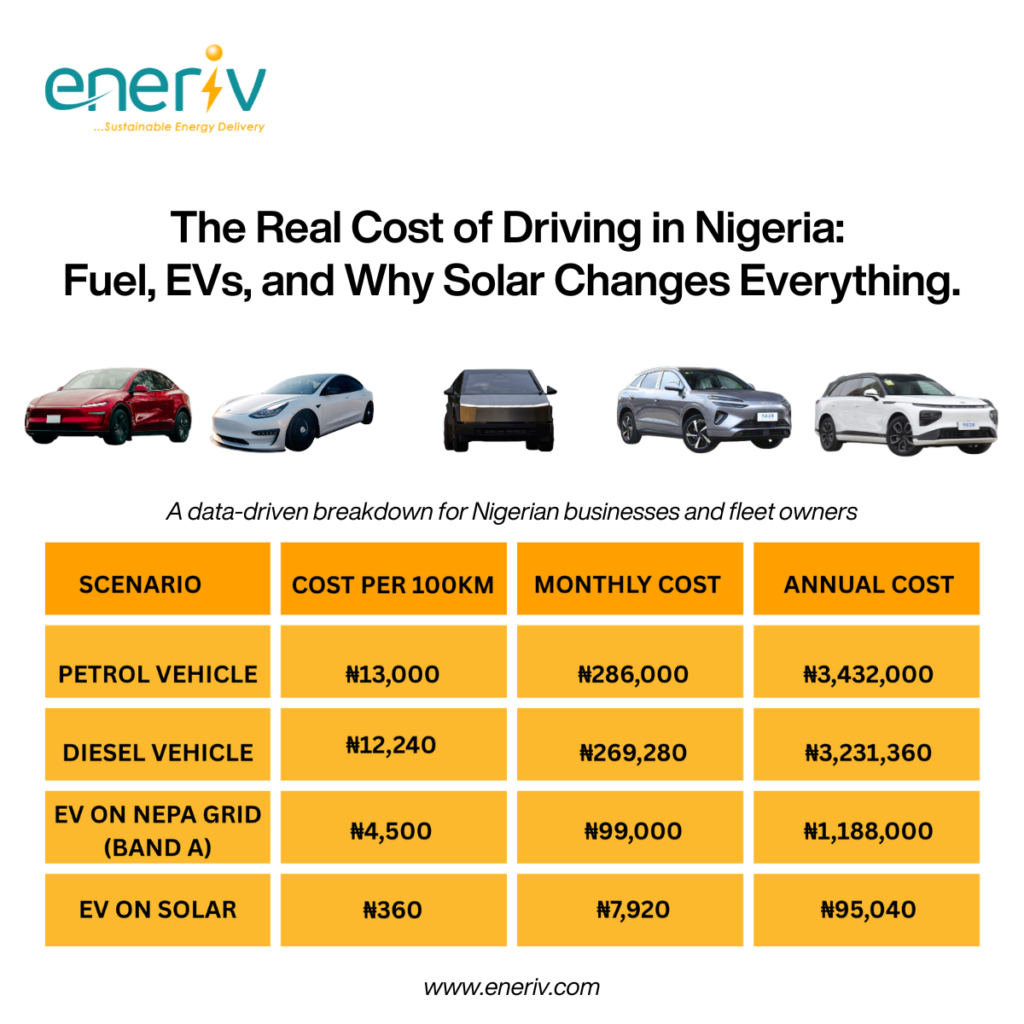
Based on: ₦1,300/litre petrol, ₦1,700/litre diesel, ₦250/kWh NEPA Band A, ₦20/kWh amortized solar. 100km/day, 22 working days/month.
When Does the Solar System Pay for Itself?
Now, this is the question that matters most for business owners.
If you are switching from a petrol vehicle to an EV + solar setup:
- Annual petrol bill: ₦3,432,000
- Annual EV + solar bill: ₦95,040
- Annual savings: ₦3,336,960
- Solar system cost: ₦10,000,000
- Payback period: approximately 3 years
After three years, the solar system is effectively paid off. And for the next 22 years, you are running your EV for almost nothing, ₦95,040 per year in residual energy costs while the person still on petrol is spending ₦3.4 million and above annually, with prices only trending upward.
Over the full 25-year life of the solar system, the total savings compared to staying on petrol exceed ₦80 million per vehicle.
What About Multiple Vehicles?
For organisations running a fleet, the maths become even more compelling. A single 10kW solar system generating 55 kWh/day can comfortably charge two EVs daily. Scale the solar installation and the savings multiply proportionally while the infrastructure cost per vehicle comes down.
A fleet of five EVs charged by a 30kW solar array? You are looking at annual energy costs of under ₦500,000, compared to over ₦17 million in petrol for five equivalent vehicles.
The Broader Case for Solar-Powered EVs in Nigeria
Beyond the cost savings, there are three additional advantages that make this combination particularly powerful in the Nigerian context:
- Energy Independence
Solar removes your dependency on both NNPC petrol supply chains and DISCO electricity distribution. You generate your own fuel without queues, price shock and outages.
- Environmental Responsibility
Nigeria’s urban centres, particularly Lagos, Abuja, and Port Harcourt, face significant air quality challenges from vehicle emissions. Transitioning to EVs powered by solar produces zero emissions and zero combustion pollution at the point of generation.
- Asset Appreciation
Solar installations increase the value of your property or commercial premises. They are long-lived assets. Tier-one solar panels come with 25-year performance warranties.
Conclusion: The Decision Is a Financial One, Not Just an Environmental One
There is sometimes a perception that EVs and solar energy are premium lifestyle choices. The numbers above tell a completely different story.
Sticking with petrol or diesel in Nigeria in 2026 is the expensive option. An EV on the national grid is already 65% cheaper to run. An EV charged by solar is 97% cheaper than petrol per kilometre.
This is not about being green. It is about being smart with money.
The organisations and individuals who make this transition now will be insulated from the fuel price volatility that will continue to squeeze everyone else. The solar system pays for itself within three years and then keeps saving money for decades.
The sun rises every day in Nigeria. It might as well be paying your fuel bill.
Considering a solar transition or EV switch? Send us a message here or send a mail to [email protected]
Figures based on NBS data (March–May 2026), current market pricing, and standard EV efficiency benchmarks. Individual results may vary based on vehicle model, driving conditions, and solar system configuration.
